
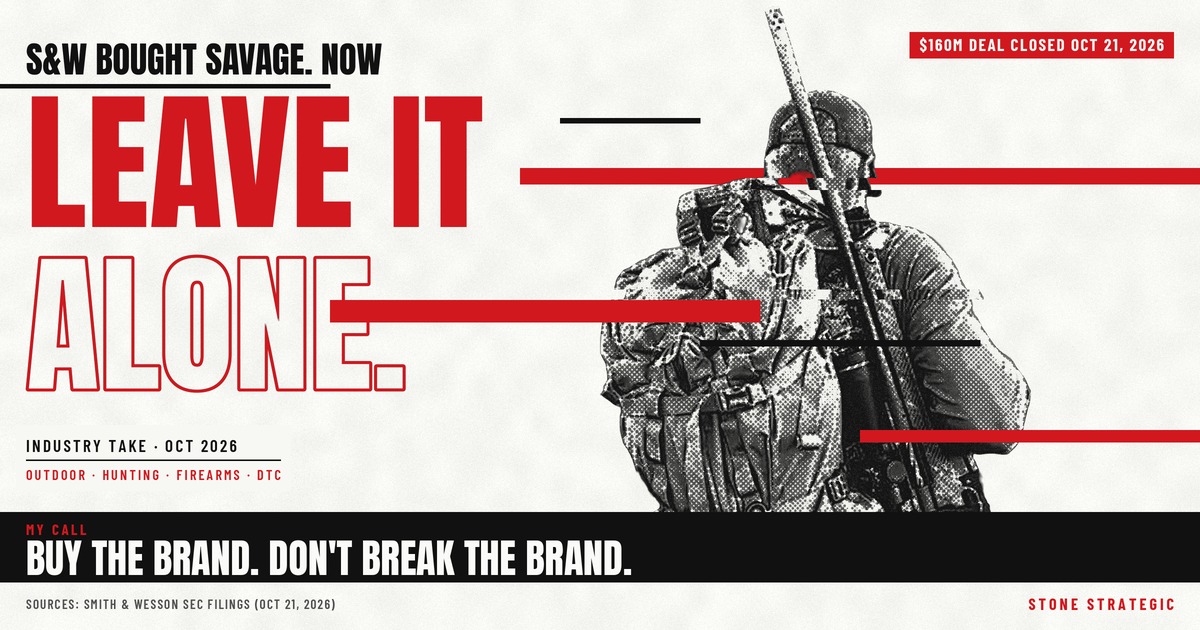
The short answer: On October 21, 2026, Smith & Wesson closed a $160 million deal for Savage Arms. Smith & Wesson calls the combined company America’s largest commercial gun maker. My take: the smartest thing it can do now is leave Savage alone. That means keeping its brand, its hunters, its dealer relationships and its voice, and merging only the back office.
Read the 8-K filed on October 21 and skip past the share count. Here’s what it says to me: Smith & Wesson just bought a hunting brand, and the best thing it can do now is not mess it up.
I’m a brand director and DTC consultant who works with outdoor, tactical and firearms brands, and that’s the lens I’m reading this deal through. Everything below is my opinion and analysis. It isn’t a prediction, and it isn’t a claim about what Smith & Wesson plans to do, because the company hasn’t said.
What did Smith & Wesson actually buy?
Smith & Wesson Brands (NASDAQ: SWBI) bought the Savage Arms business from an affiliate of Houston-based JDH Capital, paying in stock and cash. The deal signed and closed the same day. Before I give my opinion, here are the facts from the press release (Exhibit 99.1) and the 8-K:
| Item | What the filings say |
|---|---|
| Headline value | $160.0 million, “subject to customary adjustments” |
| Paid at closing | 8,993,968 SWBI shares plus $42.4 million in cash, based on an adjusted value of about $164.9 million. A final cash adjustment is still pending |
| Savage’s size | About $160 million in net sales for the 12 months ending Sept. 30, 2026 |
| Price multiple | About 7.9x Savage’s Adjusted EBITDA after $2.5 million in expected initial annual synergies |
| Seller’s stake | JDH owns 16.7% of Smith & Wesson, making it the largest stockholder, plus a board seat |
| Expected EPS impact | About $0.07 per share for a full year, about $0.10 after synergies (both excluding acquisition accounting) |
In case you’re comparing sources: the press release gives the headline structure with $37.5 million in cash. The 8-K reports what was actually paid at closing, $42.4 million, after adjustments for cash, debt and working capital.
Honestly, it looks like a disciplined deal. Under 8x EBITDA for a brand with more than 130 years behind it, paid largely in stock, with the seller staying in as the largest shareholder. That’s a lot of upside if they handle the brand well.
Why do I think Smith & Wesson should leave Savage alone?
Because Smith & Wesson’s own case for the deal depends on Savage staying Savage. Read the investor presentation (Exhibit 99.2) as a marketer and it says three things:
- “99%+ Non-overlapping Brand & Product Lines.” Savage brings bolt guns and shotguns. Smith & Wesson brings pistols, revolvers, MSRs and suppressors. There’s almost nothing to consolidate on the shelf.
- “Shared customers make up ~80% of business.” They sell to “many of the same dealers, distributors, and big-box partners, and the same hunters, shooters, and sportsmen and women.”
- The synergies it lists are operational: distribution efficiency, capacity balancing, sourcing leverage and supply chain resiliency. All of that is back office.
CEO Mark Smith said in the release that “Savage’s brand heritage, culture, and longstanding reputation for performance and innovation align closely with our own.” The release calls the deal a combination of “two iconic American brands.” In the version on The Outdoor Wire, he points to bolt-action rifles in particular.
Put that together and the playbook is simple. Save money where the customer never looks, and invest where they do. What Smith & Wesson paid for is a hunter’s trust in a Savage bolt gun and a dealer who knows how to sell one. You get synergies from the supply chain, not from the logo.
The company’s own risk language says the same thing. Its forward-looking statements flag the risk of being “unable to retain or hire key personnel,” disruption to “relationships with customers, vendors or employees,” and the “ability to maintain and enhance brand recognition and reputation.” That’s legal boilerplate, but it’s also a list of exactly what a heavy-handed integration breaks.
Hasn’t Smith & Wesson done this before?
Yes. Thompson/Center is the history every marketer in this industry should remember. In January 2007, Smith & Wesson completed its acquisition of Thompson/Center Arms, saying it provided “immediate entry into hunting rifle market.” In May 2021, it announced plans to divest Thompson/Center to “focus on its core Smith & Wesson brands.” Part of the expected benefit was “lower marketing costs,” and the company said it would serve hunting “under our iconic Smith & Wesson brand.”
| Thompson/Center (2007) | Savage (2026) | |
|---|---|---|
| Stated reason | “Immediate entry into hunting rifle market” | “Meaningfully expands Smith & Wesson’s presence in hunting category” |
| How the brand was described | Maker of “premium hunting firearms” | One of “two iconic American brands” |
| What happened next | 2021: divest, “focus on its core Smith & Wesson brands,” “lower marketing costs” | Not announced |
To be fair: Savage is a far bigger business than Thompson/Center was, and nothing in the 2026 filings points to a repeat. I’m not predicting anything. What I’m critiquing is a strategy pattern that happens all over consumer brands. When an acquired brand’s marketing gets treated as a cost line instead of an asset, the brand slowly fades until it’s easier to sell it off than to rebuild it. Savage deserves its own budget, its own voice and its own seat at the table.
What would “leave it alone” actually look like?
Combine what customers never see. Protect everything they do. If I were advising on the integration, this is the line I’d draw:
| Combine (back office) | Leave alone (what customers see) |
|---|---|
| Sourcing and purchasing | The Savage name, logo and product naming |
| Manufacturing capacity balancing | Brand voice, photography and hunting-first storytelling |
| Distribution logistics and freight | The hunters, guides and ambassadors who already carry it |
| Finance, IT and reporting | Dealer relationships, with one order desk but two distinct brand presentations |
| Shared data infrastructure | Savage’s own website, email list and service experience |
There’s a good early sign. Savage’s website was still live on October 22, according to Firearms Almanac. Firearms Almanac also points out what hasn’t been announced: anything about the brand, warranty, Westfield or Lakefield, or the other names in the Savage family. The 8-K says audited financials and pro formas will follow within 71 days. Until then, anyone telling you how Savage will be run is guessing.
What’s good about this deal, and what’s needed?
The good: dealers win on simplicity. Shooting Industry notes that most of them already carry both brands and that the deal “could simplify purchasing opportunities.” Smith & Wesson gets real hunting credibility it didn’t have to build from scratch. JDH, now the largest shareholder, has every reason to want the brand to do well.
What’s needed: someone inside the building whose job is to protect Savage as a brand, not just as a SKU list. My view is that integrations rarely hurt a brand on day one. The damage shows up in year two, when a shared marketing calendar, a shared creative team and a shared email list start sanding off everything that made the acquired brand worth buying.
The biz-dev angle: a “one-stop shop for firearms,” to use the deck’s phrase, carries a lot of weight in a distributor or big-box buyer’s office. If you’re an independent brand, you won’t out-catalog that. You compete by being the brand the dealer wants to recommend and the customer asks for by name.
What are the smartest independent brands already doing?
They own the demand, even when a dealer completes the sale. A few examples I respect:
- Staccato takes online orders paid in full, builds pistols to order, and ships to a certified dealer or the buyer’s FFL. The brand owns the customer relationship, and the dealer still gets the transfer.
- Daniel Defense sells firearms on its own site for transfer at a selected FFL. It’s the same hybrid model.
- SIG Sauer added a Gearfire-powered “Buy Now” in 2020 that sends sigsauer.com shoppers to authorized local dealers, with its Elite and Master Dealers flagged. It’s dealer-first ecommerce done right. (Smith & Wesson’s own deck cites GearFire for its market-share data.)
- Geissele runs a strong webstore. Its support page says sale pricing is web-only and not available at dealer pricing. I like the direct channel, but I’d watch how often those sales run, because buyers learn to wait.
- SureFire lists major online dealers like Brownells, MidwayUSA and Primary Arms alongside its own store, so it gets reach without giving up its storefront.
On the outdoor side, KUIU is the clearest example of an acquired brand that stayed itself. When its owner announced the sale in December 2025, the release said KUIU had grown “nearly 10x over the last 7+ years” and “will remain a privately held, independently operated brand,” with its CEO staying on. That’s the “leave it alone” principle in practice. Sitka takes a more dealer-heavy approach, with a retail locator for dealers and Sitka stores next to its own online store. Both know who their customer is.
What would I do with my money and brand right now?
I’d put money into things consolidation can’t take away. Here’s the short version:
- Own the customer list. Product registration, warranty signups, launch waitlists. Every buyer you can’t email is a buyer you’ll pay to reach again. And paid social won’t do it for firearms: Meta’s weapons ad policy still bans ads for firearms and ammunition, and even optics and flashlights.
- Make email the engine, not SMS. Klaviyo requires a 21+ age gate on a short code and doesn’t allow promoting specific firearm products by text. Twilio doesn’t allow firearms or accessories on any number type.
- Make your dealers’ job easy. Buy-now routing, a dealer locator that’s actually accurate, and content dealers can use. In a market with a one-stop shop, being easy to sell is how you compete.
- Tell your differentiation story. Who builds it, where, and why it’s worth the price. Specialists beat catalogs on story.
- Test the new channels carefully. If you sell sights, slings, mounts, bipods or braces, Google’s U.S. Search pilot is worth a tightly controlled test. And check that your checkout isn’t on a processor like Shopify Payments, which won’t support “firearms, holsters, ammunition, or weapons.”
If you’re acquiring a brand: before the deal closes, write down which customer-facing things you won’t touch for at least the first year. Look for savings in the back office first. Don’t fold the acquired brand’s email list into yours. Those customers signed up for that brand’s voice.
If you might get acquired: build the assets a buyer pays a premium for. That means a clean, permissioned customer list, direct sales history, and a brand voice that’s written down and doesn’t live only in the founder’s head.
The bottom line: Smith & Wesson bought a hunting brand. Now leave it alone.
Smith & Wesson made a smart buy. Now it has to protect what it paid for. By its own numbers, the product lines barely overlap and the customers mostly do. The savings should come from the back office, and the brand, the hunters and the dealer relationships should stay Savage’s. That’s my take, and it applies well beyond Westfield: own your customer, protect your voice, and don’t let a spreadsheet decide who you are.
FAQ
Did Smith & Wesson really buy Savage Arms?
Yes. Smith & Wesson Brands announced and closed the deal on October 21, 2026, according to its 8-K filed with the SEC. The merger agreement was signed and completed on the same day.
How much did Smith & Wesson pay for Savage?
The headline price was $160.0 million, about 7.9x Adjusted EBITDA after expected initial synergies. At closing, Smith & Wesson issued 8,993,968 shares and paid $42.4 million in cash on an adjusted value of about $164.9 million. A final cash adjustment is still pending.
Who owned Savage Arms before the deal?
An affiliate of JDH Capital, a Houston-based private investment firm. JDH now owns 16.7% of Smith & Wesson, making it the largest stockholder, and has appointed Michael Fertitta to the board.
Will Smith & Wesson keep the Savage brand?
That hasn’t been announced. The press release calls the deal a combination of “two iconic American brands,” but no brand, warranty, facility or product plans have been made public. My opinion: keeping Savage’s identity intact is the smartest move.
Why should Smith & Wesson leave Savage alone?
By Smith & Wesson’s own figures, the product lines are more than 99% non-overlapping and about 80% of the business comes from shared customers. The synergies it lists, like sourcing, capacity and distribution, are back-office. The brand and its relationships with hunters and dealers are the value to protect.
What happened to Thompson/Center after Smith & Wesson bought it?
Smith & Wesson completed the Thompson/Center acquisition in January 2007. In May 2021, it announced plans to divest the brand to focus on its core Smith & Wesson brands.
What does the deal mean for gun dealers?
Most dealers already carry both brands. Expect simpler purchasing from one larger vendor, with more negotiating weight on that vendor’s side.
How should independent firearms brands respond?
Own your customer data, route online demand to dealers, build email as your main direct channel, and lean into specialist positioning. Skip reactive discounting.
Want to know where your brand stands?
Whether you’re buying a brand, being bought, or competing with a bigger catalog, the brands that win know exactly what makes them different. If you want my straight answer on where your site, social and ads are leaving money on the table, request a free Brand Teardown. I’ll send you a PDF review with your top 3–5 fixes within 24 hours.